Showing posts with label Techlaunches. Show all posts

Saturday, April 26, 2014

Facebook launches Newswire for journalists !


                              Facebook has launched FB Newswire, with the aim to make it easier for journalists and newsrooms to find, share and embed newsworthy content from the popular social networking website in their work.
The FB Newswire is a Facebook page of hand-selected and journalist-verified news stories from across Facebook's platform, according to Andy Mitchell, director of news and global media partnerships at Facebook.
The newswire is designed to help journalists share and embed newsworthy Facebook content that is made public by its members such as photos, status updates and videos.
"Every day, news is made on Facebook. More than one billion people use our platform to discover, explore and participate in news-making events around the world," said Mitchell.
"Today, we're excited to announce FB Newswire, a resource that will make it easier for journalists and newsrooms to find, share and embed newsworthy content from Facebook in the media they produce," Mitchell said.
Powered by Storyful, that is involved in social content discovery and verification for newsrooms, FB Newswire aggregates newsworthy content shared publicly on Facebook by individuals and organisations across the world for journalists to use in their reporting.
This will include original photos, videos and status updates posted by people on the front lines of major events like protests, elections and sporting events.
FB Newswire is accessible on Facebook at Facebook.com/FBNewswire and on Twitter at @FBNewswire, and will be updated in real-time with content related to top news stories.
"In Storyful, we're excited to have found a partner with a track record of understanding both the potential of the social web as a key resource for media as well as the tools that newsrooms need to utilise it," said Mitchell.
Facebook is confident that their news expertise will help make it even easier for journalists to use compelling social content from Facebook in their news-gathering and reporting.
"News is finding a bigger audience on Facebook than ever before. Journalists and media organisations have become an integral part of Facebook, which is visible in features such as Trending Topics, improvements to Pages, and recent changes to News Feed," according to Mitchell

Friday, April 25, 2014

Ex-Apple CEO John Sculley launches Obi Mobiles in India


Former Apple CEO John Sculley has launched his own smartphone brand, Obi Mobiles, exclusively in India.
Obi Mobile is headquartered in Gurgaon and is promoted by Singapore-based Inflexionpoint.
Focused on mid-range smartphones, the company plans to take the brand and business to other growing markets in Asia Pacific, Middle East and Latin America.
Obi Mobiles plans to invest $20 million in setting up the supply chain, design centre along with sales and after sales services in the key centres across India this year.
The operations of Obi Mobiles will be led by Ajay Sharma as the CEO of the brand. Sharma has earlier established a key role in establishing HTC in India and was also associated with Micromax for the smartphone division.
It is rumoured that the Obi Mobiles devices will be priced between Rs 5,000 and Rs 8,000 and will be available in the market starting early next month.

Facebook plans to spread INTERNET using drones and satllites !!!!!!!!!!!


Facebook Inc is harnessing satellite, drone and other technology as part of an ambitious and costly effort to beam Internet connectivity to people in underdeveloped parts of the world.
The world's No. 1 social network said on Thursday it has hired aerospace and communications experts from NASA's Jet Propulsion Lab and its Ames Research Center for the new "Connectivity Lab" project.
"Today, we're sharing some details of the work Facebook's Connectivity Lab is doing to build drones, satellites and lasers to deliver the internet to everyone," Facebook Chief Executive Mark Zuckerberg said in a post on Facebook.
He gave few specifics and did not specify a time frame.
The move extends the social networking company's Internet.org effort, aimed at connecting billions of people who do not currently have Internet access in places such as Africa and Asia. Facebook has been working with telecommunications carriers to make Internet access more available and affordable.
"We're going to continue building these partnerships, but connecting the whole world will require inventing new technology too," Zuckerberg said in his post.
Facebook envisions a fleet of solar-powered drones as well as low-earth orbit and geosynchronous satellites delivering Internet access to different regions of the world. Invisible, infrared laser beams could allow Facebook to dramatically boost the speed of the Internet connections provided by the various aircraft, Facebook said on a Web page that explaining the project.
Facebook's plans to take to the skies underscore the company's rising ambitions to exert its influence beyond the confines of its 1.2 billion-member social network and to set the pace for new technology that will shape society.
On Tuesday, Facebook announced plans to acquire Oculus VR Inc, a maker of virtual reality goggles that Facebook hopes could become the computing platform of the future.
Facebook is following in the steps of Google Inc, the world's largest Internet search engine, whose Google X division is working on a variety of so-called "moonshot" projects including self-driving cars and wearable computers.
Google announced plans last year to use solar-powered balloons to deliver Internet access to remote regions of the world.
Among the jobs openings posted on Facebook's website on Thursday were roles such as Antenna Systems Engineer and Electro-Optical Network Access Hardware Engineer.
Facebook also said it had hired a five-member team that worked at Ascenta, a British company whose founders created early versions of the Zephyr, which Facebook said held the record for the longest-flying solar-powered unmanned aircraft.
Shares of Facebook were up 28 cents, or less than 1 per cent, at $61.25 in after-hours trading on Thursday

Thursday, April 24, 2014

Sony Xperia E1 Dual review: Consider if music is priority, and not the camera


Consider if music is priority, and not the camera !!!
Name: Sony Xperia E1 Dual
Price: Rs 8,210
Rating: 4/5
Specs: 4-inch display, Android Jelly Bean, 3MP camera, 1.2GHz dual core processor, 512 MB RAM, 4GB internal storage, micro SD card slot, Bluetooth, 3G, WiFi, 1700 mAh battery, 120 g
Sony's Walkman series of phones has been popular, and now the company is back with a dedicated Walkman key on its new affordable smartphone, the Xperia E1. Packing in a four-inch display, the WVGA resolution (800 x480 pixels) is somewhat lacking in brightness and colour. The power key and volume controls are on the right edge, and the Walkman key and the 3.5-mm jack are at the top. The charging port is on the left panel. The E1 feels bulky, with its 12mm thickness, and has a slightly rough finish at the back.
Sony is pitching it as a value-for-money smartphone, and has added features to live up to its promise. To start with, it's a dual SIM phone. It runs Android Jelly Bean, and is powered by 1.2GHz dual core processor from Qualcomm. The 512 MB of RAM is on the lower side, but it manages to launch all the apps without crashing. It can handle basic gaming, but don't expect it to handle heavy games. Browsing on Google Chrome was smooth.
The biggest highlight of the Xperia E1 is the Walkman app. If you use a good pair of headphones, the sound output is impressive. The Walkman app launches a feature-rich music player. For example, the ClearAudio+ mode produces a more refined and clear sound, while the xLoud feature raises the volume. The phone also packs a 3MP camera, which is somewhat underwhelming, as images have a lot of noise. The Xperia E1 comes with 4GB internal storage, of which only 2GB is user accessible. However, it can be expanded by using the micro SD card slot. When fully charged, the battery was good enough for a day, and ran low by the end of the day.

Facebook adding new "location-sharing" feature..!!!

Facebook users in the US will soon be able to see which of their friends are nearby using a new feature the company is launching on Thursday.

The "Nearby Friends" feature must be turned on by the user, so people shouldn't expect to broadcast their location unknowingly. It will use your smartphone's GPS system to tell your Facebook friendsyou are nearby - provided they have the feature turned on as well. Rather than share your exact location, it will show only that you are nearby, say, within half a mile.
If you like, you can manually share a more precise location with a specific friend you'd like to meet up with. Friends can see where you're located in a particular park, airport or city block. By default, your exact location will be shared for only an hour, although you can change this.
Nearby Friends launches amid the growing popularity of location-based mobile dating apps such as Tinder and Hinge. But unlike those apps, Facebook's feature will let you meet up only with people who are already your friends.
Facebook, whose motto has long been "move fast and break things," built a lot of precautions in this new tool as it tries to avoid privacy fiascos that often bubble up when it makes changes to its service.
The new motto, "ship love," is evident in the cautious rollout of Nearby Friends, said Jules Polonetsky, director of the Future of Privacy Forum, an industry-backed think tank in Washington. He has advised Facebook on privacy issues, including the latest feature.
He believes Facebook is showing "a deeper appreciation that with a billion users, any change needs to be implemented in a way that doesn't surprise the audience." That's especially so when it comes to privacy, especially when it comes to location sharing.
"Once you start bringing this to a mass audience, you need to be cautious," Polonetsky said, "so inadvertent oversharing is not possible."
Nearby Friends also won't be available to users under 18, said Andrea Vaccari, a product manager at Facebook. He said the tool "makes it easy to join your friends in the real world."
Of course, all the safeguards and slow rollout mean that most users won't have the feature available right away on Thursday but rather in the coming weeks and months. Initially it will go to people who are likely to appreciate it, Vaccari said, such as people who have "checked in" to various restaurants, bars or other locations using Facebook.
Unlike with other features, Facebook isn't forcing people to use Nearby Friends. Therefore, there is a possibility it won't catch on widely.
Vaccari is optimistic that it will.
Vaccari joined Facebook in 2012, when the company acquired Glancee, his startup service for meeting nearby people who have friends and interests in common. He has been working on the new feature since then.
Facebook employees have been testing Nearby Friends, and Vaccari cites ways it has helped people get together:
- When two people landed at the airport at the same time from different flights, they saw that they did through Nearby Friends and shared a ride home together.
- When two people were out shopping alone in San Francisco, they joined forces after seeing each other nearby.
Nearby Friends, Vaccari said, isn't for the five to 10 close friends whom you feel comfortable texting or calling up to hang out. Rather, he said, it's for the broader group of friends you enjoy spending time with but wouldn't necessarily call. Nearby Friends may provide that extra push. Users can limit whom they share their location with to smaller groups of friends.
Users who sign up will be shown a short tutorial on how the feature works. Besides seeing friends who are nearby, users can also see which of their friends are traveling, and in general which friends are using the feature even if they are not nearby.
Facebook says there are no current plans to draw advertising revenue from Nearby Friends. The company says it does not currently target ads to users based on where they happen to be at the moment, but uses their stated "current city" and the location of their computer based on its numeric Internet Protocol address.

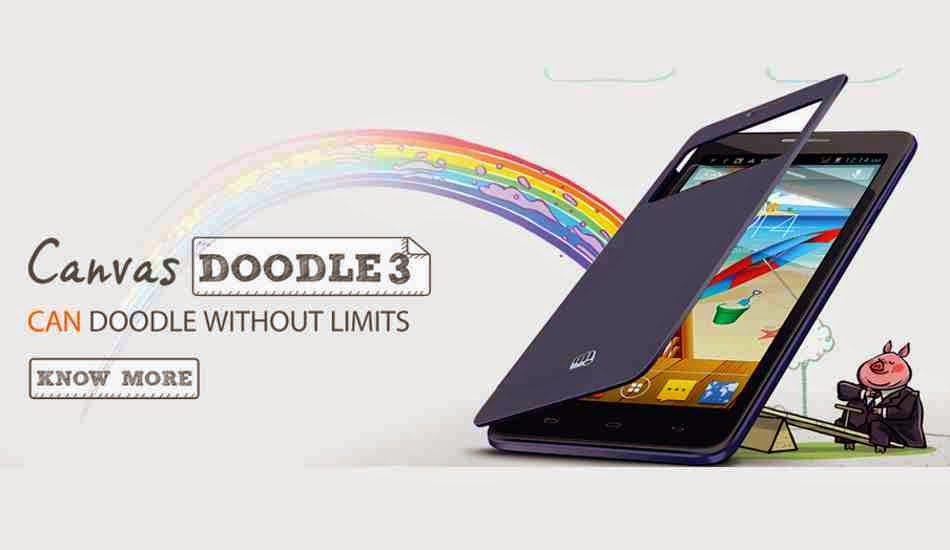
'Canvas Doodle 3' for Rs 8,500


Home-grown handset maker Micromax on Tuesday launched its new six-inch phablet 'Canvas Doodle 3' for Rs 8,500.
The Android Jellybean operating system based-device is powered by a 1.3 GHz dual core processor, 4GB ROM and 512 MB RAM (expandable memory up to 32 GB), Micromax said in a statement.
The smartphone features a 5 MP AF rear camera, 0.3 MP front camera, 2500 mAh battery and comes preloaded with M! Doodle, Bigflix, M!live, Getit, Kingsoft Office and Opera apps.
Using the M!Doodle application, users can doodle chats, animate, scribble smileys and write text over clicked pictures.
"At Micromax, we have always aimed to offer something new and different with every product launch with affordable innovation being our core DNA," Micromax CMO Shubhodip Pal said.
The Canvas Doodle 3 further reinforces Micromax's commitment to empower consumers with larger screen to help them express their imagination in a more creative way like never before, he added.
"With our foray in Russia and SAARC countries, we have charted a successful journey to become the 1st Indian hardware brand to go global. Our intentions are clearly to take Micromax to key international markets and further pursue our innovation story," he said.

HTC launches its cheapest smartphone Desire 210 at Rs 8,700

Screen size- 4 inches
Android's Jelly Bean platform
Dual GSM SIM
5 megapixel main camera and a VGA camera on the front.

                                      With an aim to more than double its market share in two years in India, smartphone maker HTC on Monday announced global launch of its lowest priced smartphone Desire 210 for Rs 8,700 in New Delhi.
"In the last 12 months or so we have been thinking about to come up with sub-Rs 10,000 product for Indian market ...if we are able to be succesful on that front it could be taken outside as well, in not just emerging market but sometime industrial economies as well," HTC President for Global sales and CFO Chialin Chang said.
He said that current market share of HTC is estimated to be around 6-7 per cent.
At Rs 8,700 price point, the 4-inch HTC Desire 210 will see competition from mobile phones like Nokia Lumia 520, Nokia X, Samsung Galaxy S Duos.
Built on Android's Jelly Bean platform, the dual GSM SIM smartphone Desire 210 has 5 megapixel main camera and a VGA camera on the front.
Besides this, HTC announced launch of its latest premium smartphone HTC One M8 for Rs 49,900 which has gesture base control on which it has high hopes globally for increasing market share. The global market share of HTC is estimated to be around 2 per cent.
"Desire 210 shipment will start from May 2 while M8 will be available across stores in India from May 7," Chang said.
HTC One M8 has 5-inch full high definition display and supports up to 209 GB of storage.
HTC unveiled its third smartphone with 5.5 inch screen size Desire 816 which supports GSM, CDMA and 3G network for Rs 23,990. This phone has 13 MP main camera and 5 MP front camera.
"HTC 816 will be shipped to India in May," HTC's Senior Director for Asia Product Marketing Darren Sng said.
Early this month, HTC unveiled Desire 310 for 11,700 which was its lowest priced phone before Desire 210.

Wednesday, March 26, 2014

Start living in a world through Glass.!!!!!


Google Glass is a project started by Google that is intended to bring hands-free display technology to the general public. By utilizing voice commands, users can interact with their Google Glass device to get information from their phones, participate in Google+ Hangouts or to get information from the internet. With a wireless data connection, Google Glass adds an augmented-reality overlay to whatever you're looking at, automatically bringing up relevant information from various Google sources. This is still a prototype project, but Google hopes to bring it to consumers sometime in 2013.
 for more info visit:Google -Glass


Wearable smart-devices represent the next stage in mobile computing and Google Glass is the most hotly-anticipated gadget in that space. It is not an extension of your Android smartphone or tablet, but is a whole new gadget in itself that can perform various day to day tasks, without you ever moving your hands. 

The computing headgear unveiled at a Google launch event in 2012 has created lot of excitement. However, though most have read and heard about the Google Glasses, there are only a few who know what it can exactly do. So, here is a look at seven cool features of Google Glass.

Record videos, take pictures

Just say the word and Google Glass will take a picture or record a video – you will never have to touch the hardware. The photos and videos will be stored on the 4GB flash memory of the device, and can also be shared on social networking websites or emailed.

Show messages

Google Glass will show you text messages as well as emails you receive and allow you to reply to them via voice commands.

Find information

If you are in the habit of Googling things a lot, you will find that your task has been made easier by the new Glass. You simply need to ask a question and the device will pull the answer from the internet. For example, you can ask when Taj Mahal was built or to give you a few photographs of the monument and the device will provide appropriate replies on the small screen in front of your eye.

Show maps

The widely used Google Maps are integrated into Glass, so that users will be able to chart the course of their journey or look up locations or establishments via voice commands.

Live video sharing

Google Glass can show the world what you are seeing – live! If you are attending a family function, your child’s school play or a concert, you can share the feed with your friends and family in real-time and make them a part of the experience.

Translate

This is a neat feature that may come in handy when you travel abroad. You simply need to ask Google Glass to translate a phrase or sentence from one language to another and it will speak that out.

A day with google glass !!!!

Monday, March 24, 2014

Sony Xperia M2 with Android v4.3 Jelly Bean


Expected Price: Rs. 20,000

Hardware and SpecificationsThe Sony Xperia M2, a mid-range Android smartphone from Sony is a device very similar to the existing Sony Xperia C in terms of hardware specifications, other than screen and exclusion of dual SIM card slots. It comes with a 1.2 GHz quad-core Qualcomm Snapdragon 400 processor which is a combination of 4 ARM Cortex A7 CPU cores and Adreno 305 GPU. For efficient multi-tasking, the Xperia M2 comes with 1GB of RAM while there is 8GB of internal storage space for installing applications and games as well as to store multimedia and personal data. There is also a microSD card slot which can be used to expand the storage by an additional 32GB. There are some necessary sensors in this smartphones like gyroscope, light sensor, proximity sensor and accelerometer.


Screen and DesignThe Sony Xperia M2 has a 4.8 inch TFT LCD screen with 5-point capacitive multitouch. A resolution of 540 x 960 pixels giving the screen on the device about 229 PPI pixel density. Considering the screen specifications, it will perform similar to the screen used in the Xperia C which had below par viewing angles. The design and external appearance is on the lines similar to the Xperia Z1 due to the use of glass front and back. Sony's signature power button, camera shutter button and volume rockers are on the right hand side of the device while the microUSB port is on the right hand side. The headphone jack is on the top while the camera, LED flash and secondary microphone are on the back of the device. This device lacks a removable back cover. The Xperia M2 is available in black, white and purple colours.


Camera and MultimediaThere is an 8MP Exmor RS camera sensor with autofocus lens, LED flash and full HD 1080p video recording. There is a VGA front-facing camera which can be used for self-portraits and video calls over Internet. The primary camera has a lot of special shooting modes such as Sweep Panorama and HDR. It comes with Sony's famous WALKMAN music player which can play a lot of audio and video formats along with an ability to convert this device into a media server over DLNA standards. Sony Music audio streaming service is also bundled to let users listen to free music through Internet.


Software and FeaturesThe Sony Xperia M2 comes with Android v4.3 Jelly Bean along with Sony's custom designed attractive UI. There are some useful additional applications and services such as Play Memories, TrackID and WALKMAN in addition to regular Google services such as Gmail, Google Maps, Google Navigation, Google Drive, Google Hangouts, etc. It also comes with a lot of personalisation options such as Xperia Themes and lock screen widgets.

Connectivity and BatteryThe Sony Xperia M2 is almost fully loaded in terms of wired and wireless connectivity. It comes with 21Mbps 3G HSDPA, dual-band Wi-Fi b/g/n, Wi-Fi Direct, DLNA and Wi-Fi Hotspot. There is GLONASS A-GPS for location and navigation needs. There is also a microUSB v2.0 port for data transfer through PC. There is a 2300 mAh non-removable Li-Ion battery which can easily last over a day of normal usage after a full single charge. There is also Sony's famous Battery STAMINA mode which comes in handy to prolong the battery endurance of the device.- See more at: http://www.mysmartprice.com/mobile/sony-xperia-m2-msp3937#sthash.UzPsYiRG.dpu

Nokia X Android phones officially its something !!!!!!

                                                      It's in the process of being bought by Microsoft but that isn't stopping Nokia launching a line of Android-based smartphones.

Announced at Mobile World Congress in Barcelona today, the new family of products will be called Nokia X.


A mid-range device featuring a 4-inch screen atop a 1GHz dual-core CPU from Qualcomm, paired with 512MB of RAM and 4GB of on-board storage (expandable up to 32GB). There will also be an X+ device with additional storage and an XL device, which is physically larger.

However, this is not a standard Android phone. Unlike well-known products such as those from Sony, HTC and Samsung, this model uses the open-source Android code as its base, but not its front end. Like Amazon's Kindle Fire, this means the code underneath the user interface is Android but it does not resemble a typical Android phone. In fact, Nokia has styled it to look a lot like Windows Phone, in part to make "migration" from Nokia X to Lumia more welcoming down the line.

                                   As such there's no Google Play store. However, the "overwhelming majority of Android apps" will be supported via third party app stores, according to a Nokia spokesperson briefing Wired.co.uk, and "hundreds of thousands" will be available to download immediately. Nokia X devices will include Nokia's own app store that provides a curated storefront for Android software downloads, and others such as the popular Yandex app store can be installed. Microsoft apps including Outlook and Skype will also be installed by default, alongside Facebook, BBM, Opera web browser, Sim City and Vine.

                                   A reason given for such an atypical appearance choice for Android was for simplicity's sake, Nokia says. The company aims for its user interface, called Fast Lane, to make Android more user-friendly to those buying their first smartphone. So while price- and specifications-wise the first Nokia X device would sit alongside the likes of the Huawei Ascend Y300, it's not fair to see them as direct competitors given the Huawei's use of the full Android interface.

Nokia is aiming for this family of Android devices to help it connect "the next billion people to the cloud" in areas such as China, Russia, South America and other regions seeing a rising adoption of smartphones. As such, although a spokesperson confirmed Nokia plans to bring the X line to western Europe "eventually", it is not a goal for launch in March.


North America, Japan and Korea are also out of luck -- the Nokia X line will not launch in these areas at all.

Sunday, March 23, 2014

Intel's incredible Edison PC is the size of an SD card !!!


Look closely. That's not an SD card. Rather, it's the Intel Edison - a full x86 PC with Pentium-class specs.
Unveiled at CES 2014, the Edison runs on Linux and is powered by Intel’s dual-core Quark system-on-chip processor. One core spins at 400MHz, while the other varies between 50MHz and 200MHz depending on the task's demands. Everything but the kitchen sink fits snugly into this SD card form factor, including 512MB RAM, flash storage, Wi-Fi and Bluetooth LE connectivity.
This means smaller and smarter consumer tech is headed your way: it's all part of Intel CEO Bryan Krzanich's plan to make every object smart - particularly those we can wear.

                                                   That's what Edison brings to the table - a PC with full-fledged features, without the associated bulk that’ll make smart gadgets big and clunky.
The functionality was demonstrated by Intel with a US$200 Edison-equipped baby onesie from Rest Devices loaded with sensors, tracking the infant's temperature and pressure.
An Edison-eqipped mug with an LED screen collects the data from the outfit and changes the mug’s 'face' from a smiley green to an angry red when the toddler turns cranky. Intel also showed off an Edison-equipped bottle warmer that activates when the baby stirs from his slumber.
In short, Intel’s Edison is hitting the right notes with the Internet of Things, in a future where just about any device or object - appliances, chairs, wearables - could be equipped with processing capabilities. 
In order to spur the imaginations of developers exploring wearable tech, Intel is also offering US$1.3million in 'Make It Wearable' prizes for gadgets that use Edison to enhance their capabilities. So if you think you can beat the smart onesie, it's time to get making.
Edison will be out 'in the middle' of 2014 for an as-yet unspecified price.


Windows 8.1 Update 1 – with Mind-Blowing Features


                                            Microsoft is preparing a small upgrade to Windows 8.1, offered as a package update that introduces new features and reduce RAM consumption, enhancing system performance on Windows 8 tablets.

                                                     Described as “a relatively minor update” Update 1 package will be available free to update devices with Windows 8.1 from 11 March. Delivered by the Windows Update service, package update brings yet important changes in the structure of the operating system, in order to lessen the requirements for RAM and storage space. The measure is intended to prepare the ground for a new wave of tablets with Windows 8.1 system with reduced set of specifications and selling price ranged for the budget solutions.
On the surface, Windows 8.1 introduces support for fastening Modern UI applications in the taskbar from desktop interface and display thumbnails on their content then move the cursor over. In the chapter “innovations” we also introduce the Close button in the Modern UI application interface that provides owners with touch screen devices a practical way to close the applications they no longer need. Also for users that have mouse and keyboard is the new set of menus available by right-clicking the Modern UI interface.
Still used as the primary display, the Home Screen will finally have a Shutdown button, positioned in the upper right corner, next to the new Search button. Unfortunately those who hoped to see introduced a “Mini” version for Home Screen, which mimic the old Start Menu in Windows 7, will probably remain disappointed.

Thursday, March 20, 2014

Pencil by 53


                                                                                  If the iPad forever changed the way we consume content,pencil might forever change the way we create it.53 is the company behind apple's app of the year,paper,and their pencil is the perfect companion for the app.This device is stylus,but some very smart programming means that you can do on the iPad what you can do on real paper with real pencil in your hand.The perfect designer buddy.
Connectivity: Bluetooth.
Material:Graphite or Aluminium.
Sensors: 14kt gold plated nose and eraser
 PRICE:3,800/-


check out:http://www.fiftythree.com/